Part of Kasi & Hustle: guides and tools for informal and township businesses.
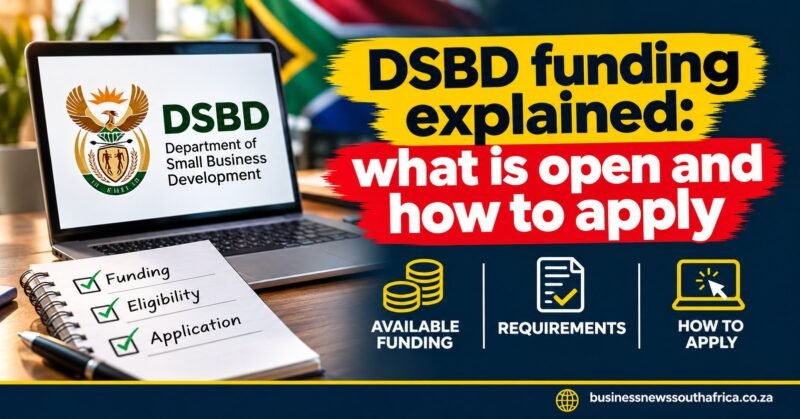
Township business funding in South Africa comes from a short list of government programmes, and most of them ask for the same few things: a registered business, a bank account and an owner who runs the business day to day. The amounts run from a R100 000 spaza grant up to loans of R3 million, R15 million and more, and the rules differ on age, ownership and what the money can buy. This guide lines the routes up by size, shows what each one asks for, and says which to try first.
It is for owners of spazas, hair salons, taverns, food stalls, workshops and other township and rural businesses, and for anyone planning to start one. Every programme figure below was read on the funder’s own page on 25 November 2026, except the NEF and IDC ranges, which are from their own brochure and website as noted. None of the pages we read shows a promise of approval, a budget or a turnaround time, and terms change, so check the linked page before you apply. This is general information, not financial advice.
Why finance is hard for township businesses
Standard Bank’s 2025 Township Informal Economy Insights Report, which we covered in our report on the R900 billion township economy, surveyed more than 250 businesses in five provinces. It found that nearly 80% were not registered, fewer than 9% had access to a bank loan and 57% relied on personal savings. The bank’s own write-up of the report has the findings. The gap is not only money. Funders want paperwork that many informal businesses have never needed, which is why the first job is usually to get registered, as we explain in our guide on how to register a spaza shop.
The routes, from smallest to largest
| Programme | What it offers | Who it is for |
|---|---|---|
| Spaza Shop Support Fund | Up to R100 000 in total: stock grant up to R40 000, assets and infrastructure up to R50 000 (grant and loan), training up to R10 000 | South African citizens running registered spazas in townships or rural areas |
| Informal and Micro Enterprise Development Programme (IMEDP) | Training, then a 100% grant for basic equipment and tools | Black-owned informal and micro enterprises that have traded for at least three months |
| Asset Assist Programme | Machinery, equipment, working capital and raw materials up to R250 000 | Businesses 100% owned by South African citizens that employ at least 90% South African citizens |
| Peo Pele Youth Fund | R250 000 to R5 million | Youth-owned businesses, owners aged 18 to 35 |
| Township and Rural Entrepreneurship Programme (TREP) | Up to R3 million, 5% or 8% fixed, up to 60 months | Township and rural businesses owned 100% by South Africans |
| Youth Challenge Fund | Up to R2 million for start-ups, up to R15 million for growth enterprises | Owners aged 18 to 35 |
| National Empowerment Fund (NEF) | R250 000 to R75 million | Black-owned and black-managed businesses |
| Industrial Development Corporation (IDC) | R1 million to R1 billion | Start-up and existing businesses of that size |
Spaza Shop Support Fund: up to R100 000
The Department of Small Business Development’s page splits the support into a stock grant of up to R40 000 for the initial purchase of stock through a delivery channel partner, an assets and infrastructure amount of up to R50 000 as a blended grant and loan for things like building upgrades, refrigeration, shelving and security, and training of up to R10 000. According to SAnews’s step-by-step guide of 23 July 2026, the owner must be a South African citizen or naturalised before 1994, the business must operate in a township or rural area and be registered with the municipality, applicants must be registered with SARS or qualify for a six month transitional period, and the owner must actively manage the shop. Priority goes to young entrepreneurs aged 18 to 35, women-owned businesses and businesses owned by people with disabilities. CIPC registration is optional, except that funding above R80 000 requires it within six months. Applications go through the SEFA portal named on the fund’s website. Our Spaza Shop Support Fund guide has the practical detail.
IMEDP and Asset Assist: equipment and tools
The IMEDP page says qualifying entrepreneurs get basic business management training followed by a 100% grant for basic equipment and tools. The basic criteria are at least three months of trading, a South African, black-owned informal or micro enterprise, a certified South African identity document for the owner and employees, proof of banking (personal or business) and, for a stokvel, proof of the stokvel. Applicants must also complete mandatory training at SEDFA branches. The Asset Assist page lists machinery, equipment, working capital and raw materials up to R250 000, for businesses 100% owned by South African citizens, employing at least 90% South African citizens, with a valid business address and CIPC documents (sole proprietors excepted). Neither page shows a closing date or an open or closed status, which our report on what the Department of Small Business Development has open describes as “no public call”. Contact SEDFA to confirm before you prepare an application.
TREP: up to R3 million
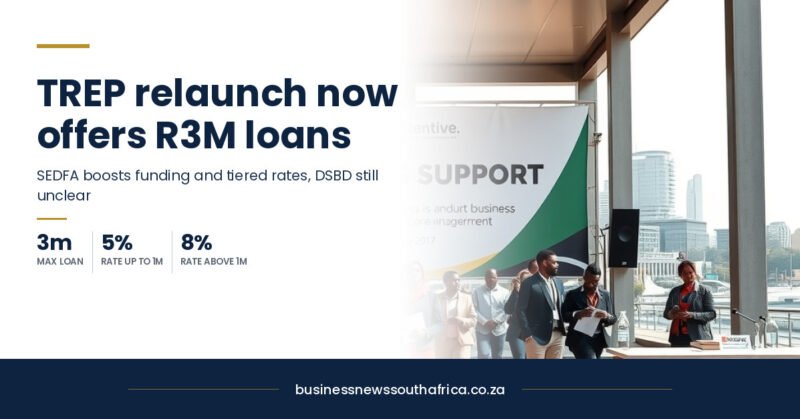
SEDFA’s TREP page states funding of up to R3 million per business, with a fixed rate of 5% on loans up to R1 million and 8% fixed on facilities above R1 million up to the R3 million ceiling, repayment of up to 60 months, a moratorium of up to six months on capital and interest based on cash flow, and blended finance of a 60% loan with a grant of up to 40%. Our report on the TREP relaunch explains the conditions that are easy to miss, including a three to six month business development programme and payment straight to suppliers. The department’s own advisory mentioned only a 5% rate, so confirm the rate in writing before you sign.
Youth funds: Peo Pele and the Youth Challenge Fund
Both SEDFA pages, for Peo Pele and the Youth Challenge Fund, list the same core criteria: aged 18 to 35, registered with CIPC and prepared to register with SARS and UIF, 100% South African owned, and adequately involved in running the business day to day. Peo Pele funds R250 000 to R5 million. The Youth Challenge Fund offers a mix of loan and grant of up to R2 million for start-ups and up to R15 million for growth enterprises. SEDFA’s pages share text between the two funds, so confirm with SEDFA which fund fits your business.
NEF and IDC: larger and industrial
The NEF’s May 2026 products brochure says it provides business loans from R250 000 to R75 million for start-up, expansion and equity acquisition, and requires investees to be directly involved in the business. It funds black-owned and black-managed businesses, and its how to apply page sends applicants to its online portal. Our NEF explainer covers the ownership tests. The IDC’s funding solutions hub says it funds start-up and existing businesses with a minimum requirement of R1 million and a maximum of R1 billion, so it suits industrial and larger projects, as in our IDC explainer.
Which door to try first
- Trading but not registered: register with your municipality first. Nearly every route above asks for it. See our spaza registration guide.
- A spaza that needs stock, a fridge or shelving: the Spaza Shop Support Fund is built for exactly that, up to R100 000.
- A very small informal business that needs tools or equipment: IMEDP, with training first, or Asset Assist for up to R250 000.
- Owner aged 18 to 35: Peo Pele or the Youth Challenge Fund, and the youth priority on the Spaza fund.
- A business ready to borrow R250 000 to R3 million: TREP, or the NEF if the business is black-owned.
- A factory, large project or R1 million minimum: the IDC.
What every funder asks for
Across the pages above the checklist repeats: a certified South African identity document, proof of the business address, proof that the business is operating, a valid business bank account (see our guide to business bank accounts), a municipal licence or permit where the programme requires one, and SARS registration. Several programmes also require CIPC registration, 100% South African ownership and an owner who is actively involved in running the business. Put the documents in one folder before you start any application.
Before you sign anything
- Know what must be repaid. Blended finance means a loan portion. A moratorium delays repayment, it does not cancel it.
- Check the rate and who gets the money. TREP funds may be paid straight to suppliers, according to its brochure as we reported.
- Apply through the funder’s own website. The NEF states there is no application fee. If anyone asks you to pay to “secure” or “fast-track” funding, check with the funder directly first.
- Keep dated copies of the pages you relied on, in case terms change.
Frequently asked questions
What is the easiest government funding for a spaza shop?
The Spaza Shop Support Fund is aimed at spazas and offers up to R100 000, covering stock, assets and infrastructure, and training. It requires municipal registration, SARS registration or a six month transitional period, and South African citizenship or naturalisation before 1994.
Do I need to be registered with CIPC?
Not for the Spaza Shop Support Fund below R80 000, where CIPC registration is optional. For funding above R80 000 it is required within six months. TREP, Peo Pele and the Youth Challenge Fund list CIPC registration among their criteria.
Is any of this money a grant I do not repay?
Some is. The Spaza fund’s stock and training amounts are grants, IMEDP is a 100% grant for equipment after training, and TREP’s blended finance includes a grant of up to 40%. Most other amounts above those are loans or a grant and loan mix, so read the terms.
Can a foreign national apply?
Most programmes above require South African ownership: the Spaza fund asks for South African citizens or those naturalised before 1994, and TREP, Peo Pele, the Youth Challenge Fund and Asset Assist ask for 100% South African ownership. Check each programme’s page for its exact rule.
Are these programmes open right now?
Several pages show an Apply now button but none we read states a closing date, a budget or a turnaround time. IMEDP and Asset Assist show no public call. Confirm with SEDFA or the funder before you spend time on an application.
What is the difference between SEDFA, NEF and IDC?
SEDFA implements the Department of Small Business Development’s programmes for small and micro businesses. The NEF is a dtic agency funding black-owned businesses from R250 000. The IDC is a development finance institution funding from R1 million.
Where can I get help with an application?
SEDFA branches run the training that IMEDP requires and handle applications for its programmes. The Spaza fund lists a call centre on 011 305 8080, according to SAnews. Check each funder’s page for current contact details.
This guide is general information, not financial advice. Programme details were read on the funders’ pages cited, as at 25 November 2026, and may have changed since. Always apply through the funder’s official channel.