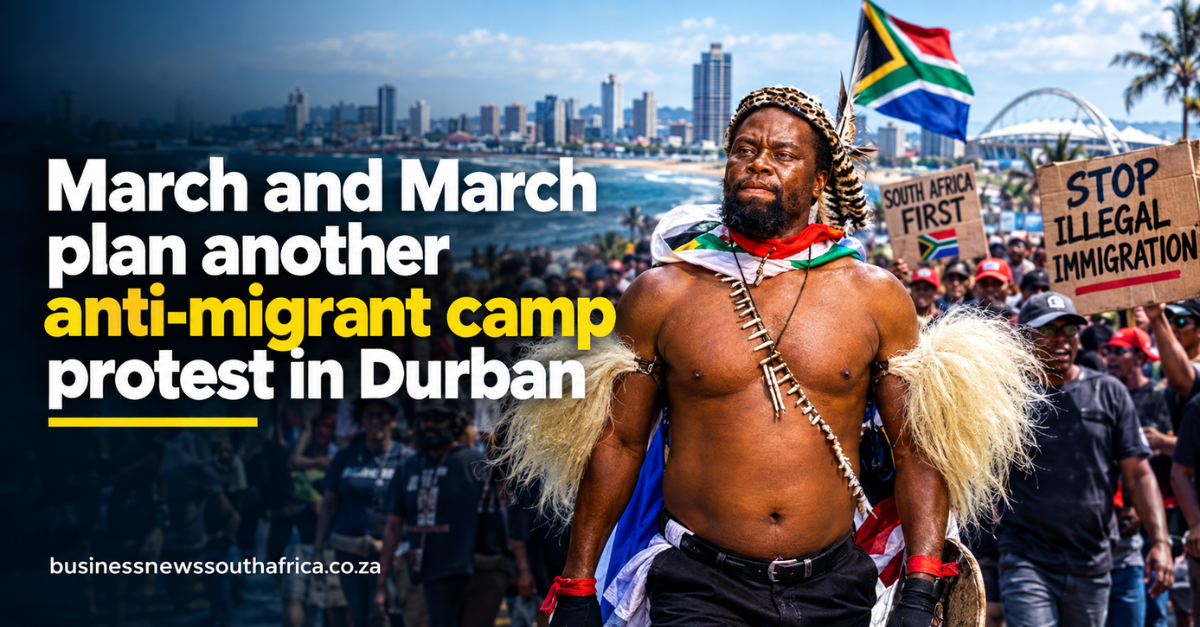
According to EWN, the activist group March and March will hold another demonstration against camping migrants in Durban. The statement does not give a date, route or expected crowd size, only that a repeat protest is planned.
For owners of small shops, restaurants and tourism-related enterprises in the city, the relevance lies in the potential for road closures, heightened security costs and a dip in foot traffic. Durban’s central business district and beachfront precincts rely heavily on a steady flow of locals and visitors; any disruption can translate into lost sales for a shop that depends on daily customers.
Why the protest matters to local commerce
Protests that block major arteries such as the N2 or the M4 have, in past instances, forced retailers to adjust opening hours or temporarily shut down. A 2023 street demonstration against a different issue saw some retailers report a 10% drop in sales on the day of the event, according to a survey by the Durban Chamber of Commerce. While the current march is aimed at migrant camps, the logistical impact on traffic and public perception can be similar.
The group’s claim, that the protest is necessary to address what it calls “illegal camping”, is a political stance, not a verified fact about the legality of the sites. Local authorities have not yet confirmed whether permits have been issued or whether police will allocate additional resources to manage the march.
What remains unknown are the precise timing, the scale of the gathering and any official response from the municipality. Those details will determine how much preparation small businesses need to make, whether that means arranging extra security, informing staff of possible delays, or simply monitoring the situation on the day.
In the meantime, owners can mitigate risk by staying in touch with local business associations, reviewing contingency plans for supply deliveries and keeping customers informed through social media if access to their premises is affected.
The cover most small businesses assume they have and do not
Business owners planning around any kind of protest activity run into a gap in their insurance that is widely misunderstood, and it is worth checking before it is tested rather than after.
Standard commercial insurance policies in South Africa generally exclude damage arising from riot, civil commotion, public disorder, strikes and similar events. This is not an oversight or fine print designed to catch anyone out. Those risks are excluded from ordinary cover because they are difficult to price and tend to produce many claims simultaneously in the same area, which is precisely the pattern conventional insurance is not built to absorb.
South Africa’s answer to that gap is a separate state-owned insurer, Sasria, which exists specifically to cover these special risks. Cover is bought as an add-on through an existing insurer or broker rather than directly, which is one reason owners are sometimes unclear about whether they have it. The practical step is a short call to a broker asking two questions: whether the policy includes it, and whether the sum insured still reflects what the business is actually worth, since a figure set a few years ago may no longer cover replacement stock and equipment at current prices.
Planning for disruption rather than damage
Damage is the less likely outcome. Disruption is the common one, and it is not usually an insurance question at all.
The costs that accumulate on a disrupted trading day are ordinary and largely avoidable with a little notice: staff who cannot reach the premises or cannot safely get home afterwards, deliveries that arrive to find no access, perishable stock ordered for volumes that never materialise, and customers who assumed a business was closed because nobody told them otherwise.
Each has a cheap answer if it is thought about in advance. Delivery windows can be moved. Perishable orders can be trimmed for a specific day and restored the next. Staff arrangements can be agreed beforehand rather than improvised on the morning. And a single message on whichever channel a business’s customers actually use, saying whether it is open and how to reach it, recovers a meaningful share of trade that would otherwise simply go elsewhere.
Local business associations are generally the fastest source of reliable information on road closures and timing, ahead of both official channels and social media, because their members are calling one another anyway. For a business in an affected precinct, being on that distribution list is the cheapest piece of contingency planning available.