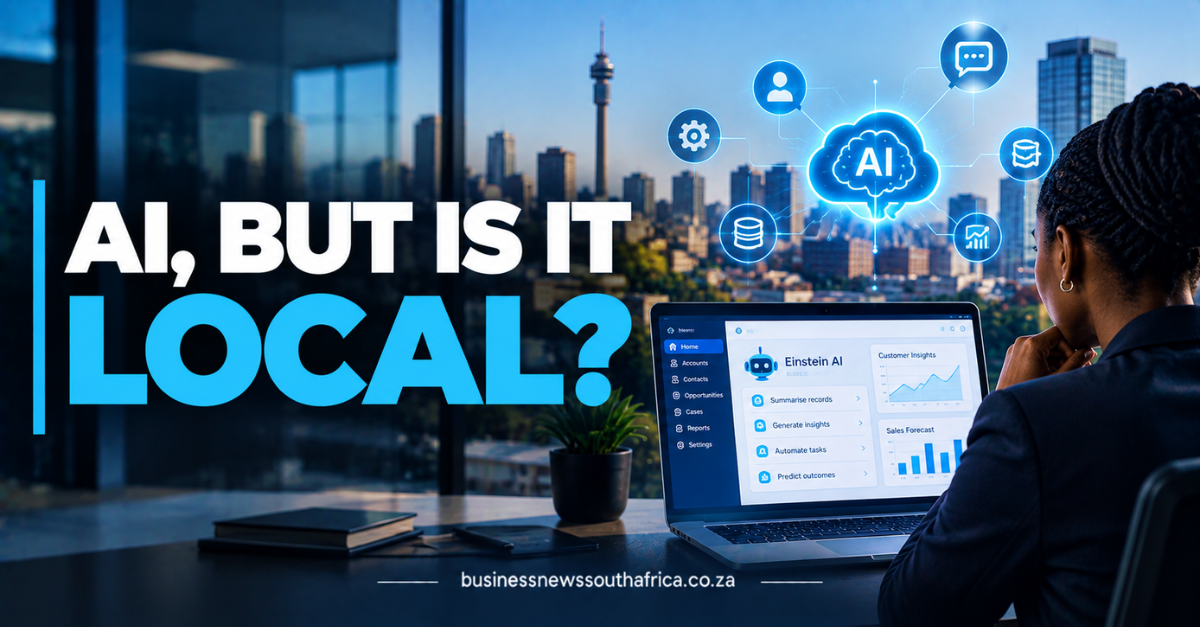
htxt.co.za published a brief headline asking whether Salesforce’s latest artificial-intelligence (AI) offerings will give South African users more relevant results. The piece contains no further detail, so the question remains open.
Salesforce is a US-based cloud-software company best known for its customer-relationship-management (CRM) platform. In early 2024 the firm rolled out a set of generative-AI tools under the Einstein brand, including text-generation, code-assist and data-insight features. Generative AI refers to technology that can create new content, such as written copy or code, based on prompts, rather than simply analysing existing data.
For South African small and medium enterprises (SMEs), the promise is clear: AI could automate routine tasks, personalise marketing messages and speed up decision-making. However, the local context adds layers of complexity. South Africa has eleven official languages, a data-localisation push from regulators, and a digital-infrastructure landscape still coping with load-shedding and uneven broadband coverage. These factors can affect how well a globally designed AI model understands local dialects, complies with data-storage rules and delivers consistent performance.
Industry observers note that many AI providers are still fine-tuning models for non-English inputs and for the nuances of African markets. Without a specific rollout plan for South Africa, it is unclear whether Salesforce’s new tools will automatically adapt or require additional localisation work by the user.
Businesses considering the technology should weigh the potential productivity gains against the costs of integration, training and possible data-privacy compliance steps. The Markets & Finance section will monitor any official statements from Salesforce or local partners that clarify the rollout strategy.
What Salesforce’s AI platform actually looks like in 2026
Salesforce’s generative-AI push has moved on from the Einstein Copilot branding referenced in early coverage of the technology. Its current platform, Agentforce, positions itself as an autonomous AI-agent system rather than a chat assistant, with Salesforce having released a set of named agents built for specific roles, from outbound sales to supply-chain management, ahead of its 2026 Dreamforce conference. The distinction matters for South African firms evaluating the tool: an autonomous agent that can independently execute multi-step tasks carries a different data-governance and oversight burden than a copilot that only suggests text, which sharpens rather than resolves the localisation and compliance questions htxt.co.za’s report raised.
The specific compliance question POPIA raises
Any South African business feeding customer data into a cloud-based AI tool such as Agentforce needs to consider section 72 of the Protection of Personal Information Act, which restricts transferring personal information to a third country unless that country has data-protection laws providing adequate safeguards, or the data subject has consented to the transfer. Since Salesforce’s infrastructure and model training pipelines are largely US-based, a South African firm adopting its AI tools for customer data typically needs to rely on contractual safeguards in its service agreement with Salesforce rather than assuming POPIA compliance is automatic, a step that is easy to overlook when the appeal of a new AI feature is speed rather than governance.
What a South African firm should ask before adopting the tool
Before integrating any Agentforce-style AI agent into a customer-facing workflow, a South African business should confirm where the underlying data is processed, whether the vendor’s standard contract includes POPIA-compliant data-processing terms, and whether the AI agent’s outputs are logged in a way that can be audited if a customer disputes a decision the agent made on its own. None of those questions are unique to Salesforce, but they become more urgent with an autonomous agent than with a simple chatbot, since an agent that can take independent action carries more downstream accountability if something goes wrong.
Businesses can find guidance on cross-border data transfer rules directly from the Information Regulator, the body that enforces POPIA in South Africa.