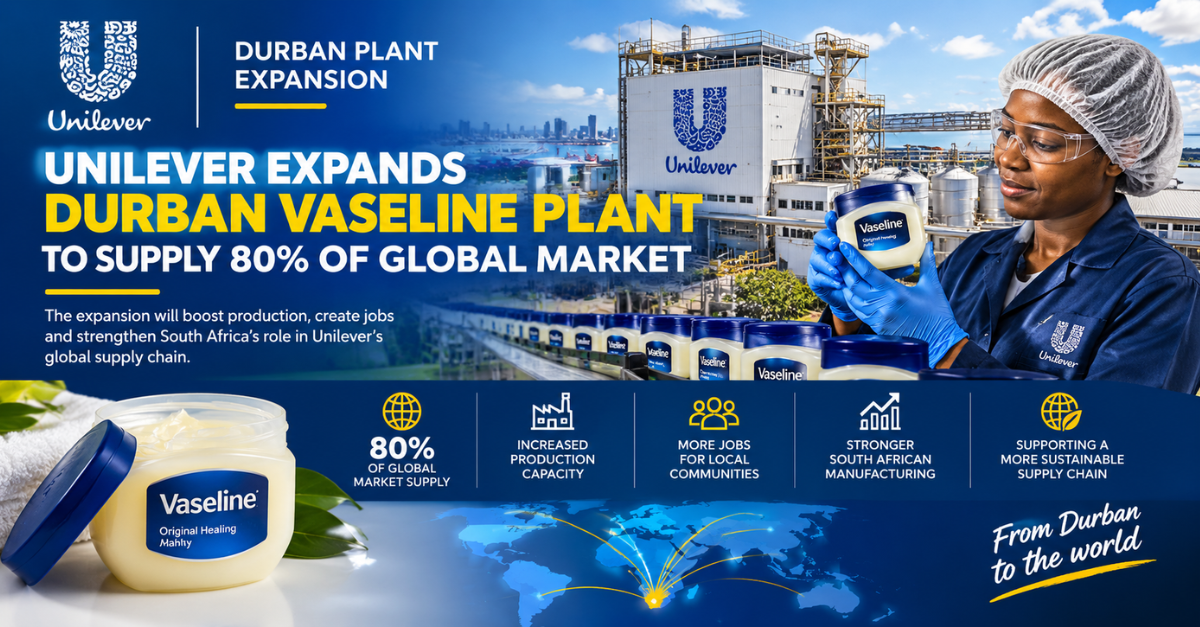
Unilever South Africa has opened a new Vaseline production line at its Maydon Wharf facility in Durban, raising the plant’s share of global petroleum-jelly supply from 60% to 80%. The announcement was made at a ribbon-cutting ceremony on 2 October 2026, attended by Deputy Minister of Transport Mkhuleko Hlengwa, KwaZulu-Natal Premier Thami Ntuli, eThekwini Mayor Cyril Xaba and Unilever Southern Africa CEO Stefan Cloete. The news was reported by Moneyweb.
The upgrade cost R100 million and adds a modern production line equipped with German and Italian machinery. The plant now employs roughly 350 full-time staff and 200 freelancers, and the project involved 68 engineering and fabrication teams and more than 100 tonnes of steel cabling.
Supply-chain vice-president Phahle Phalane said that about 95% of Unilever’s products sold in South Africa are already manufactured locally, and that the company has lifted its local sourcing of raw materials from 40% in 2019 to 80% in 2025. The expanded Vaseline line therefore relies more on South African inputs, which could create additional contracts for local suppliers.
Mayor Xaba highlighted parallel infrastructure spending in the Durban port area, including R450 million for road upgrades in Prospecton and close to R600 million for bulk infrastructure in the Westown precinct. Those projects are expected to attract roughly R15 billion of investment and generate thousands of jobs, reinforcing the city’s role as a logistics hub.
Unilever’s global sales reached €50.5 billion (about R945 billion) in 2025 across 190 countries, and industry estimates place the Vaseline brand’s value between $5 billion and $10 billion (R83 billion to R166 billion). The Maydon Wharf site, which first opened in 1912 as a soap factory, now serves both African markets and export customers, illustrating how a historic plant can be repurposed for modern, high-volume production.
For small-business owners and local contractors, the expanded capacity and related infrastructure upgrades signal potential new procurement opportunities and a more stable demand for logistics services. The move also underscores Unilever’s long-term commitment to South African manufacturing, a factor that may influence future investment decisions in the sector.
Read more about similar corporate investments in the Markets & Finance section.
Stefan Cloete described the new line as “a vote of confidence in South Africa’s manufacturing future and in the talented people who make Maydon Wharf such an important part of Unilever’s growth story.” He highlighted that the R100 million injection not only upgrades capacity but also preserves the plant’s heritage that began with Sunlight bar soap in 1912, turning it into a multi-technology hub that now serves both African markets and export customers, reinforcing the company’s ambition to keep trusted brands in the country.
Mkhuleko Hlengwa, speaking at the KwaZulu-Natal Transport Indaba 2026, called the upgraded facility a “stellar example of how industrial development can be anchored in port infrastructure.” He noted that the proximity to Durban’s container terminals reduces logistics costs and provides certainty for the workforce, creating a stable employment environment that can adapt to fluctuations in global demand for petroleum-jelly.
Thami Ntuli emphasized that Unilever’s expansion tells a story of partnership, noting that the company has helped shape the province’s industrial landscape. He added that Vaseline’s export earnings feed directly into the local economy, and that the port’s connectivity “links you to every place that matters,” positioning Durban as a gateway for South African manufactured goods to reach global markets.
While Unilever leads the global market, it faces competition from Procter & Gamble and L’Oréal, yet the Vaseline brand does not disclose a standalone net worth. Industry analysts, however, place its valuation between $5 billion and $10 billion, underscoring the strategic importance of maintaining a dominant share of the worldwide petroleum-jelly supply.
The commissioning process began with 68 engineering and fabrication teams installing German and Italian machinery, followed by the laying of more than 100 tons of steel cabling across the plant. After mechanical assembly, the line underwent rigorous testing and calibration to meet safety and quality standards before receiving final approval from local regulators, after which full-scale production commenced.
Increasing local sourcing from 40 % in 2019 to 80 % in 2025 reshapes the supply chain by reducing reliance on imported raw materials, lowering transport emissions and creating new contracts for South African suppliers. This shift supports job creation, skills development and inclusive growth, as more of the value-added processes remain within the country, aligning with Unilever’s long-term industrialisation strategy.