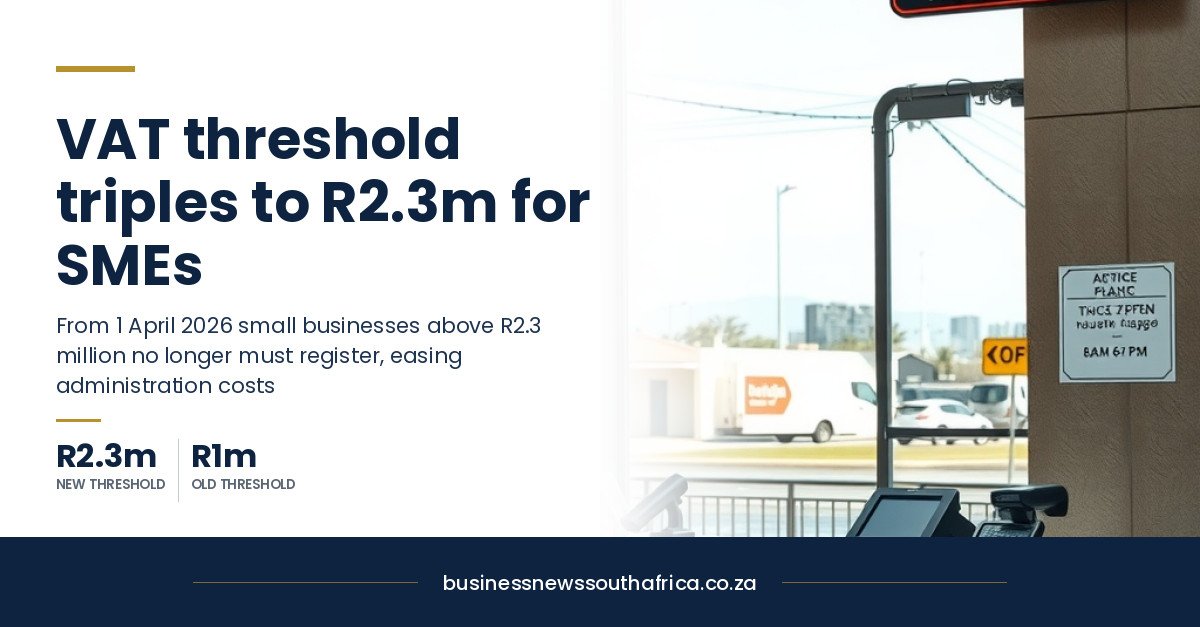
For seventeen years, a South African business earning more than R1 million a year had no choice: register for VAT, charge it, file returns, or fall foul of SARS. That threshold had not moved since 2009. On 1 April 2026 it did, and by a wide margin. Finance Minister Enoch Godongwana raised the compulsory VAT registration threshold from R1 million to R2.3 million in the 2026 Budget Speech on 27 February, Standard Bank reported, the first adjustment to that number in seventeen years. The voluntary registration threshold moved too, from R50,000 to R120,000.
A second, related change matters just as much. The turnover tax ceiling, the annual revenue cap for South Africa’s simplified tax for very small businesses, also rose from R1 million to R2.3 million, with the tax-free portion increasing from R500,000 to R600,000, according to SARS’s own turnover tax guidance. A business that could never have qualified for turnover tax before now might, and one already registered for VAT may find it no longer has to be.
None of this is automatic. Nobody is deregistered or moved onto a different tax regime without applying. And for some businesses, deregistering is the wrong move even where it is now legally possible.
What actually changed, in numbers
- Compulsory VAT registration: R1 million a year → R2.3 million a year.
- Voluntary VAT registration: R50,000 a year → R120,000 a year.
- Turnover tax eligibility ceiling: R1 million a year → R2.3 million a year.
- Turnover tax tax-free portion: R500,000 → R600,000.
All four took effect on 1 April 2026, per the Budget legislation. Turnover tax itself is charged on a sliding scale for the 2026/27 tax year: 0% up to R600,000, 1% on the amount from R600,001 to R950,000, then R3,500 plus 2% up to R1.4 million, then R12,500 plus 3% above that, up to the new R2.3 million ceiling.
Why Treasury moved the number
The R1 million line had stood still since 2009 while the cost of running a small business had not. Godongwana told Parliament that “compliance costs have not kept pace with the rising cost of doing business”, and Standard Bank’s Head of Business & Commercial Banking, Simone Cooper, called the change “a welcome and practical measure” that gives owners “breathing room… to focus on expansion rather than administration”. The practical effect: a business turning over, say, R1.5 million a year, comfortably a real, employing small business, was compelled into monthly or bi-monthly VAT administration purely because the old threshold had never been adjusted for inflation. That business is no longer required to be a VAT vendor at all.
Should you actually deregister?
This is where the good news needs a caution attached. VAT registration is not only a burden. A registered vendor claims back the VAT it pays on stock, equipment, rent and services, input tax that a non-vendor simply loses. Deregistering makes sense for a business whose customers are mostly individuals, who cannot claim VAT back anyway and were never going to notice its absence from an invoice. It makes far less sense for a business selling to other VAT-registered companies, who generally prefer, and in some tenders require, a VAT invoice, and for any business that spends heavily on VAT-able inputs relative to its turnover.
There is also a genuine trap in the deregistration process itself. Section 8(2) of the VAT Act contains what tax practitioners call a “deemed supply” rule: when a vendor deregisters, everything still on the business’s books, stock, equipment, even intellectual property, is treated as though it were sold to the business itself immediately before deregistration, and output VAT at 15% becomes due on it. Tax Consulting SA’s Micaela Paschini and Megan Langton put it plainly: “deregistration is not always a simple administrative step,” and a business that claimed input VAT on a bakkie, a compressor or a shopfit years ago can find that value clawed back as a single VAT bill on the way out the door. Their advice is to value everything the business owns before applying to deregister, work out what input VAT was claimed on it historically, and check whether any of the Act’s exclusions apply, rather than assume a smaller number on the VAT201 form is automatically a win.
What to do next
- Work out your actual annual turnover, and where it sits against R2.3 million, R950,000 and R600,000.
- If you are VAT-registered and now fall under R2.3 million, do not deregister before valuing your business assets and checking the deemed-supply exposure above. A conversation with an accountant here is worth its fee.
- If you are not VAT-registered and your customers are other VAT-registered businesses, weigh voluntary registration (now open from R120,000 of turnover) against staying out of the system.
- If your turnover is under R2.3 million and mostly comes from a simple trade with few deductible expenses, look at turnover tax as an alternative to standard company tax: the qualification test and registration run through SARS’s own turnover tax page.
Our free VAT Calculator works out exactly what VAT you owe or can claim on a transaction, and our beginner’s guide to tax filing covers the filing calendar this sits inside.