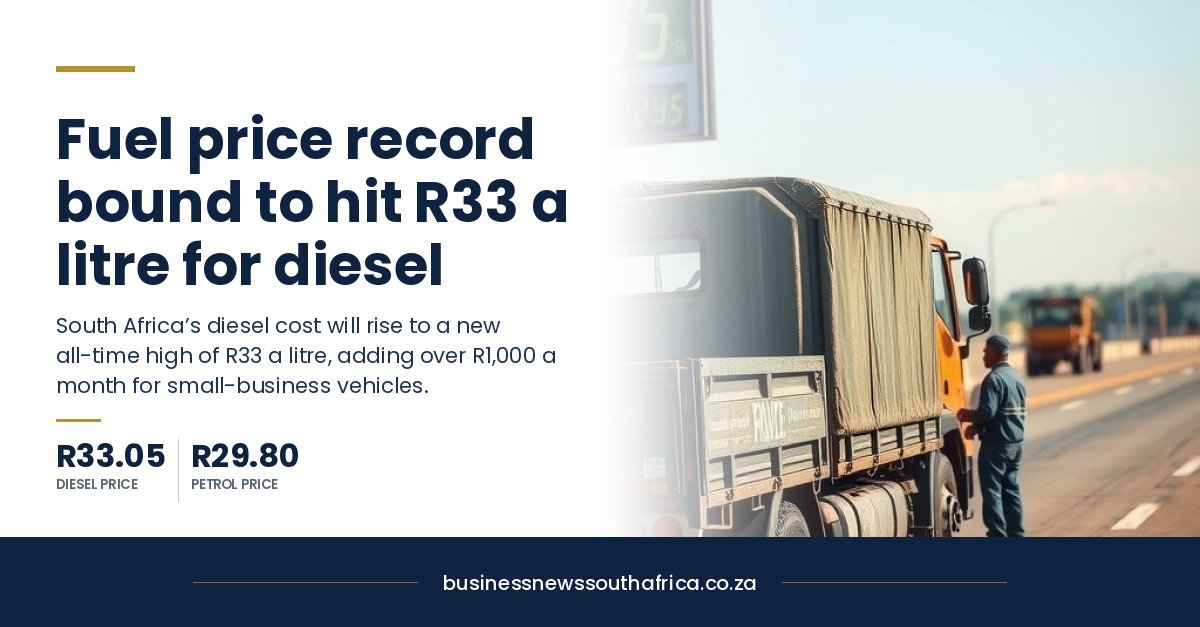
The October fuel price hike that South African motorists were warned about at the start of the month has not stayed put. It has grown. Data from the Central Energy Fund (CEF) up to 22 September, tracked by Stuff, points to increases of R2.88 a litre for 95 petrol and R3.00 a litre for 50ppm diesel on Wednesday 7 October. In the first week of September, the same data pointed to R1.93 and R2.03. In a fortnight, the expected hike added almost another rand a litre.
If those numbers hold, both petrol and diesel will set new all-time records.
What the pump will show
The Department of Mineral and Petroleum Resources’ September adjustment put 95 petrol at R26.92 a litre inland and R26.05 at the coast, and the wholesale price of 50ppm diesel at R30.05 inland. Adding the latest projected increases gives the following October prices:
- 95 petrol: about R29.80 a litre inland and R28.93 at the coast.
- 93 petrol: an increase of about R2.71, taking it to roughly R29.47 inland.
- 50ppm diesel: about R33.05 a litre wholesale inland, before the retail margin a filling station adds.
- 500ppm diesel: up about R2.60 a litre.
- Illuminating paraffin: up about R3.15 a litre, the steepest rise of any product, and the one that hurts low-income households most.
The current petrol record is R28.06 a litre, set in June 2026, according to CAR magazine. Diesel’s record was set in May, the first month 50ppm diesel went above R30 a litre. The projected October prices clear both comfortably.
Why it keeps getting worse
South Africa sets its fuel prices from the average of international product prices over the previous month, converted at the average rand exchange rate. The rand has held up reasonably well. The problem is oil. Brent crude has spent September above $100 a barrel, compared with roughly $70 earlier in the year, as conflict in the Middle East and damage to Russian refining capacity squeeze supply. Every day in September that oil stayed high added to the monthly average, which is why the projected hike rose steadily through the month rather than settling.
There are still a few trading days left before the averaging window closes, so the final number can move either way. The department normally announces the official adjustment a few days before it takes effect. But with only days to go, a large reversal would need a sharp fall in oil prices or a sudden jump in the rand, and neither looks likely.
What it costs a small business
For businesses with vehicles on the road, the diesel number is the one that matters. Here is a simple illustration. A delivery bakkie using 9 litres per 100km and covering 4,000km a month burns about 360 litres of diesel. An extra R3.00 a litre adds roughly R1,080 a month to that one vehicle’s fuel bill, or nearly R13,000 a year if prices stay at October’s level. A business with five vehicles is looking at about R5,400 more a month.
Petrol commuters feel it too. A car using 8 litres per 100km and covering 1,500km a month would pay around R345 more each month at the projected 95 petrol increase.
The fuel hike also lands on businesses already carrying higher financing costs. The Reserve Bank raised the repo rate to 7.25% on 23 September, pointing to the fuel shock as the main inflation risk, and August’s inflation reading of 4.4% was already being pushed up by diesel. October’s increase will feed into transport costs, food prices and the next inflation print.
What owners can do before 7 October
- Fill up before Wednesday 7 October. Filling every vehicle’s tank on Tuesday 6 October locks in September prices for one more tank.
- Review delivery pricing now. If you charge customers for delivery or call-outs, check whether the rate still covers a R33 diesel price. Many small operators set it when diesel was below R25 and have not adjusted since.
- Check fuel clauses in contracts. Longer contracts sometimes include a fuel escalation clause linked to the official price. If yours has one, October is the month to apply it, in writing.
- Look at routes, not just prices. Combining trips and planning delivery rounds usually saves more than hunting for a cheaper filling station, since retail margins vary little between stations.
Longer term, the government’s review of the fuel price formula, which Minister Gwede Mantashe has said could show a much lower “true” fuel cost once levies are separated out, is not due until March 2027. We covered what that review can and cannot change. It will do nothing for October.