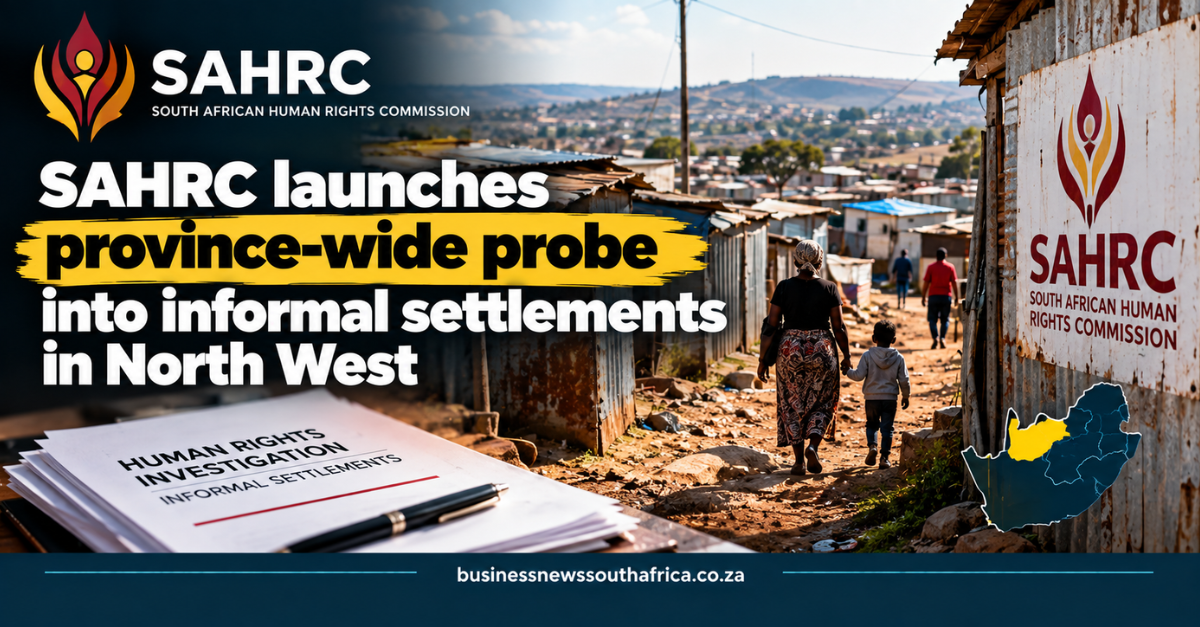
The South African Human Rights Commission (SAHRC) announced on 20 September 2026 that it will investigate the entire North West province over concerns about poor service delivery in informal settlements.
An informal settlement is a community that has developed without formal planning approval and typically lacks reliable water, sanitation, electricity, waste removal and proper roads. The commission says prolonged residence in such conditions can breach residents’ human rights, affecting dignity, health and safety.
The investigation will examine the extent of informality across the province, the quality and adequacy of basic services, and the progress of government programmes aimed at developing or upgrading settlements. It will also look into the causes of delays and how temporary or interim services measure up against human-rights standards.
To gather evidence, the SAHRC will request information from municipalities, provincial departments and other state organs, conduct targeted site inspections, and accept written submissions from residents, community organisations, traditional leaders, academics and civil-society groups. Submissions must be received by 30 October 2026 and can be emailed to the protected address in the notice or posted to 25 Heystek Street, Rustenburg. Those unable to submit in writing can call the North West Provincial Office on 063 728 8544 for alternative options.
For residents, the probe could lead to clearer timelines for upgrading or relocation, improved access to water, electricity and sanitation, and stronger accountability for promises made by local authorities. Service providers and contractors may also feel pressure to deliver upgrades more quickly, potentially creating short-term business opportunities but also exposing them to scrutiny if standards are not met.
The commission will assess how settlement locations affect access to schools, health facilities and emergency services, and will highlight examples of successful upgrading initiatives where they exist. Findings will be compiled alongside public submissions and inspection reports before the commission releases its final assessment.
Read the full announcement on BusinessTech. For more coverage of regulatory developments, visit our Regulatory & Policy section.
“In some instances, communities have remained in informal settlements for extended periods while awaiting development, upgrading or relocation,” the commission said, adding that such prolonged stays can erode dignity, health and safety, especially for children, older people, persons with disabilities and other vulnerable residents, a concern not yet highlighted in the earlier coverage.
The SAHRC asks contributors to identify the settlement’s name and location, the responsible municipality, the nature and duration of the problem, the specific services affected and details of any engagements with government, including the responses received, thereby creating a detailed evidentiary base for the probe.
Temporary or interim services provided while communities wait for permanent upgrades will be examined to determine whether they meet human-rights standards, with particular attention to water, sanitation, electricity, refuse removal and road access, a focus that expands on the commission’s initial service-quality assessment.
Submitters may also attach supporting material such as correspondence with government departments, photographs, petitions, community memoranda, meeting records and reports, allowing the commission to corroborate written statements with tangible proof of conditions on the ground.
Information gathered from public submissions will be weighed alongside data obtained from municipalities, provincial departments, targeted site inspections and other relevant sources, ensuring that the final report reflects a balanced view of both official records and lived experiences.
After the 30 October 2026 deadline, the commission will compile all inputs, analyse the causes of delays and the adequacy of interim services, and then publish its final assessment, which will include recommendations for remedial action and timelines for upgrading or relocating affected settlements.
The commission’s request for details on “limited or inadequate access to water, sanitation, electricity, refuse removal, roads and other essential services” aims to map service gaps across the province, a focus not yet highlighted in earlier coverage. By gathering specific examples of where these utilities fail, the SAHRC can compare conditions against the minimum standards set out in national human-rights frameworks. Residents have been urged to note not only the absence of services but also the frequency and duration of any intermittent provision, allowing investigators to distinguish chronic shortages from temporary disruptions caused by infrastructure repairs.
In addition to utility shortfalls, the probe will assess how settlement placement influences residents’ ability to reach schools, healthcare facilities and emergency services, a factor that directly impacts the right to education and health. The commission seeks evidence of travel distances, transport availability and any barriers such as unsafe routes or lack of lighting. By correlating these access challenges with service-delivery data, the investigation can identify settlements where location compounds the effects of inadequate basic services, thereby amplifying the overall human-rights impact.
The SAHRC’s methodology includes targeted inspections of selected informal settlements, a step that will verify the accuracy of written submissions and provide visual documentation of conditions on the ground. Inspectors will record observations on infrastructure quality, the state of interim service installations and any signs of health or safety hazards. Photographs, meeting minutes and community memoranda submitted by residents will be cross-checked with on-site findings, ensuring that the final report reflects both reported experiences and independently verified evidence.
After the 30 October 2026 deadline, the commission will synthesise public inputs with data obtained from municipalities, provincial departments and the inspection reports. This combined analysis will form the basis of recommendations that outline remedial actions, timelines for upgrades or relocations and mechanisms for monitoring compliance. The final assessment will be published with a clear outline of how each identified shortfall will be addressed, providing a roadmap for municipalities to meet their obligations under the human-rights framework.