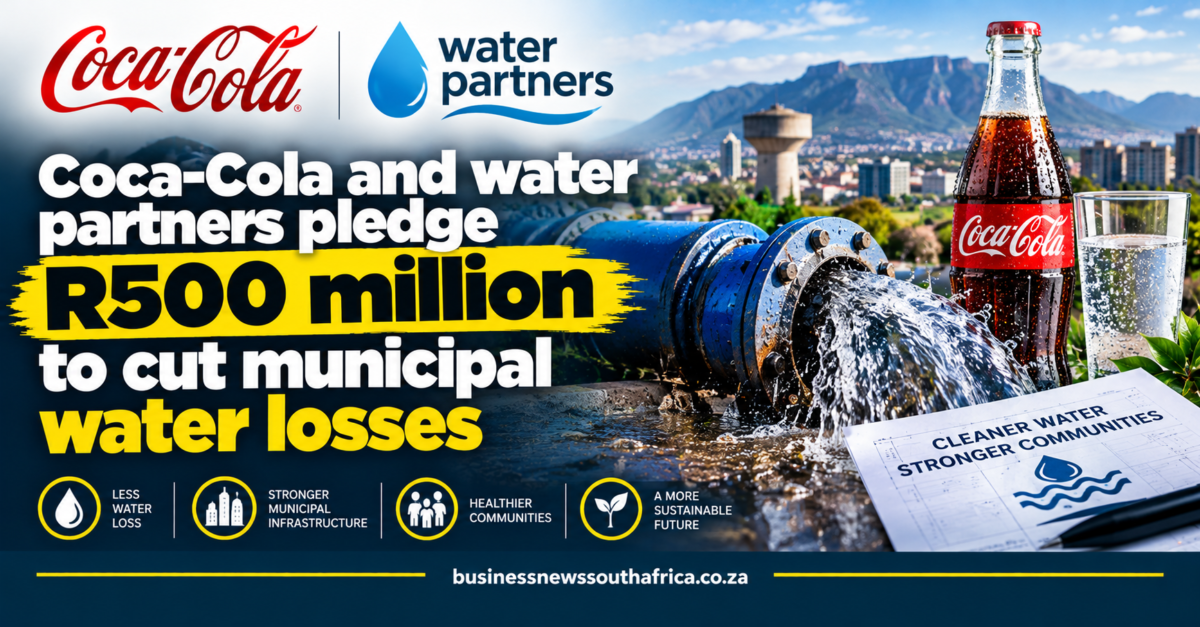
According to a report by BusinessTech, Coca-Cola and a group of water sector leaders have signed a public-private agreement to mobilise R500 million for municipal water infrastructure between 2026 and 2031. The partners made the pledge after a meeting with President Cyril Ramaphosa.
The partnership, called the South Africa Non-Revenue Water Mechanism, brings together five public and development entities, the Department of Water and Sanitation, Rand Water Services, the City of Tshwane, Platform for a Water Secure Gauteng and the World Bank Group’s 2030 Water Resources Group, and two private participants, the Coca-Cola system (Coca-Cola Beverages Africa and Coca-Cola HBC) and the Glocal Water Challenge. The private partners aim to mobilise R250 million, to be matched by another R250 million from the public-sector partners.
Where the water goes
South Africa currently loses about 47% of its treated water to pipe leaks, deteriorating infrastructure and non-revenue water, which is water that is treated but lost before it reaches any paying customer.
What the Tshwane pilot will do
Phase one will start with a pilot in the City of Tshwane, covering Pretoria, Centurion, Akasia and surrounding areas. The first steps are pressure management, which means installing automated valves and controls to regulate pressure in municipal pipes, since pipes often burst or leak when pressure is too high, and systems to improve monitoring and accountability of industrial effluent.
Industrial effluent is the wastewater that factories and industrial facilities produce. Left unmonitored it can damage municipal drainage, overload treatment systems or escape proper billing. Dedicated monitoring equipment will track the volume and quality of that wastewater, which can hold businesses accountable for environmental compliance and ensure they pay a fair share of municipal treatment costs.
What the partners said
“Water security is fundamental to South Africa’s economic growth, community resilience, and long-term sustainability,” said Luis Felipe Avellar, President of the Coca-Cola Company’s Africa operating unit. He added that the initiative “demonstrates how collaborative action can help attract private investment and address critical water sector challenges”, and that it provides “a scalable, catalytic model that could be replicated across South Africa”.
Water and Sanitation Minister Pemmy Majodina welcomed the initiative on behalf of government. “Through the work of the National Water Crisis Committee, we continue to drive collaborative solutions that strengthen municipal capacity and accelerate progress in addressing critical water challenges,” she said.
Zoran Bogdanovic, CEO of Coca-Cola HBC, which has agreed to acquire a majority stake in Coca-Cola Beverages Africa and is actively supporting the project, highlighted the importance of collaboration among government, business and development organisations. He said such partnerships lay a strong foundation for improving water security across Africa.
The work will begin in Tshwane but is designed to expand into other municipalities over time. The goal is a repeatable framework for attracting private funding into municipal infrastructure and improving the long-term financial stability of local municipalities.
For more on the broader water strategy, see the Department of Water and Sanitation and the World Bank. This story is part of the Energy & Infrastructure coverage.
Related: Durban and Johannesburg face highest water outage rates in South Africa.