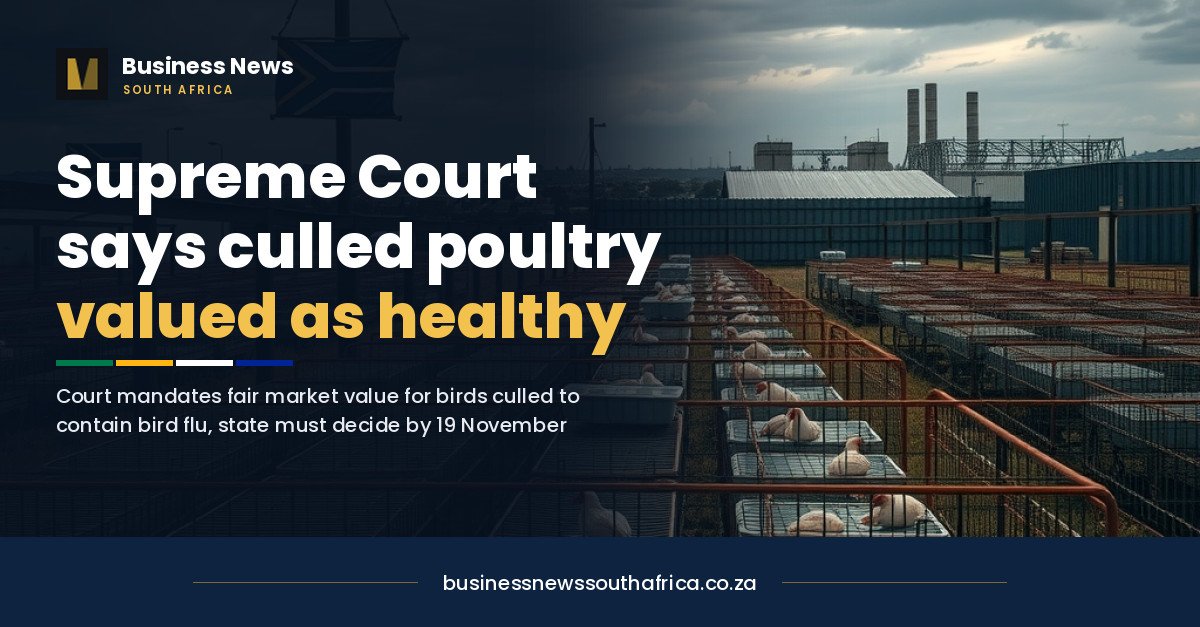
The Supreme Court of Appeal has ruled that poultry and eggs destroyed on state orders to stop bird flu must be valued as if they had never been infected when compensation is worked out. The judgment was delivered on 28 October 2026 by a three-to-two majority, and it dismissed appeals by the Director of Animal Health and the Minister of Agriculture. It does not fix a rand amount for anyone. It does remove the argument the state used to pay nothing, and the State has until 19 November 2026 to decide whether to take the matter to the Constitutional Court.
A note on sourcing before the detail. We could not read the judgment itself. The two public law libraries that publish Supreme Court of Appeal rulings blocked our automated request with a 403 error, and we did not try to get around that. The account below therefore rests on the South African Poultry Association (Sapa) statement, which Sapa issued as a party that supported the case, as carried by Bizcommunity and Engineering News, and on earlier reporting on the same dispute. Where a statement is Sapa’s view, we say so.
What the court decided
The case arose from an avian influenza outbreak in May 2021 at George Moerasrivier Boerdery, a Western Cape egg producer. State veterinary authorities ordered infected and exposed birds and eggs destroyed, and the farmer complied. Section 19 of the Animal Diseases Act lets owners apply for compensation when animals or other property are destroyed or disposed of under official control measures.
According to Bizcommunity, the Director of Animal Health twice set compensation at zero. Her reasoning, as Sapa describes it, was that infected and exposed birds had no value because they were likely to die and could not be traded. The Supreme Court of Appeal majority disagreed, holding that birds and eggs should be valued on the basis that they were not infected or exposed, using fair market value.
The ruling has limits that matter for anyone expecting a cheque. Bizcommunity reports that the court did not set a final amount, and that the matter goes back to the Director. She must still decide what is payable, taking into account the circumstances of each claim and the relevant factors under the Act. Those factors include any value returned to the owner, amounts the owner owes the State and insurance payments. The judgment also separates animals destroyed under official control measures, which can attract compensation, from animals that died before the measures were imposed, which are not covered by the compensation provision, Bizcommunity says.
How the dispute got here
The same farmer won a first round in the High Court. Daily Maverick reported in July 2024 that Judge Judy Cloete, in a judgment delivered on 21 June 2024, found that “applicable compensation” should be based on the fair market value of the animal or thing in a healthy state, relying on a 2008 Supreme Court of Appeal decision. She sent the claim back to the Director. The farmer’s own assessment of what it lost across two farms, as reported then, was R31 892 847.63, covering more than 387 000 chickens and about 5.4 million eggs. That is the farmer’s figure, not a number any court has accepted.
The 2024 judgment is also where Sapa’s industry figures appear. Sapa’s Izaak Breitenbach told Daily Maverick that more than 100 farms were affected and put the industry’s loss at R9.5 billion, and IOL’s report from June 2024 quotes him saying farmers lost more than R10 billion in 2023/24. These are the association’s own estimates and we have not tested them. Daily Maverick added at the time that, despite the Act and an earlier appeal-court judgment, government had not paid compensation to farmers. We found no official figure for how many claims remain open today.
What the industry says it means
Sapa supported the litigation as a friend of the court. Breitenbach, who heads its Broiler Organisation, is quoted as saying: “Compulsory culling can remove a farmer’s productive flock in a matter of days.” Sapa’s argument, which the judgment is reported to have accepted in part, is that compensation encourages farmers to report disease quickly. The prospect of receiving nothing, the association says, can discourage reporting and weaken containment. News24’s headline on the ruling says billions in claims could follow. We could read only the introduction of that article, so we cannot say how it arrives at that figure.
Sapa has called for outstanding claims to be dealt with fairly and promptly in line with the judgment. Bizcommunity adds that, if the Director does not seek leave to appeal to the Constitutional Court, the Minister or the Department of Agriculture could take steps to facilitate compensation in line with the ruling. None of that has happened yet.
What it means for businesses
For egg and broiler producers with culled flocks, the ruling changes the starting point of a claim from zero to market value in a healthy state. It does not guarantee full payment, because the Director can still adjust for insurance payouts, value returned and money owed to the State. Producers, their insurers and their lenders will want to read the full judgment, once it is available, before assuming any figure.
Feed suppliers, hatcheries, packers and retailers sit downstream of those farms. Sapa has warned in the past that culling without compensation has medium- to long-term price implications for consumers. That is an industry position, not a finding. Our report on Astral Foods’ earnings guidance covers one listed producer’s year.
Beyond poultry, the principle reaches other livestock sectors that face state-ordered destruction. We have tracked the state’s handling of foot-and-mouth disease, including the 1 501 open outbreaks in a department report and the import of 23 million vaccine doses. Whether this judgment will be cited in claims over other diseases is a legal question we cannot answer from the sources we could read. For investors weighing the sector, our agro-processing guide covers the incentives, finance and risks.
What is still unknown
- The majority and minority reasoning. Two of five judges disagreed, and we have not seen why.
- Whether the Director of Animal Health will seek leave to appeal to the Constitutional Court by 19 November 2026.
- How much the Director will now award in this case, and how long that will take.
- How many other claims are pending, their combined value, and what the State has budgeted for them. We found no official figure.
- Whether the department will set a process for outstanding claims, or leave each farmer to pursue its own.
We will update this report when the judgment text is available to us, or when the State announces its next step.