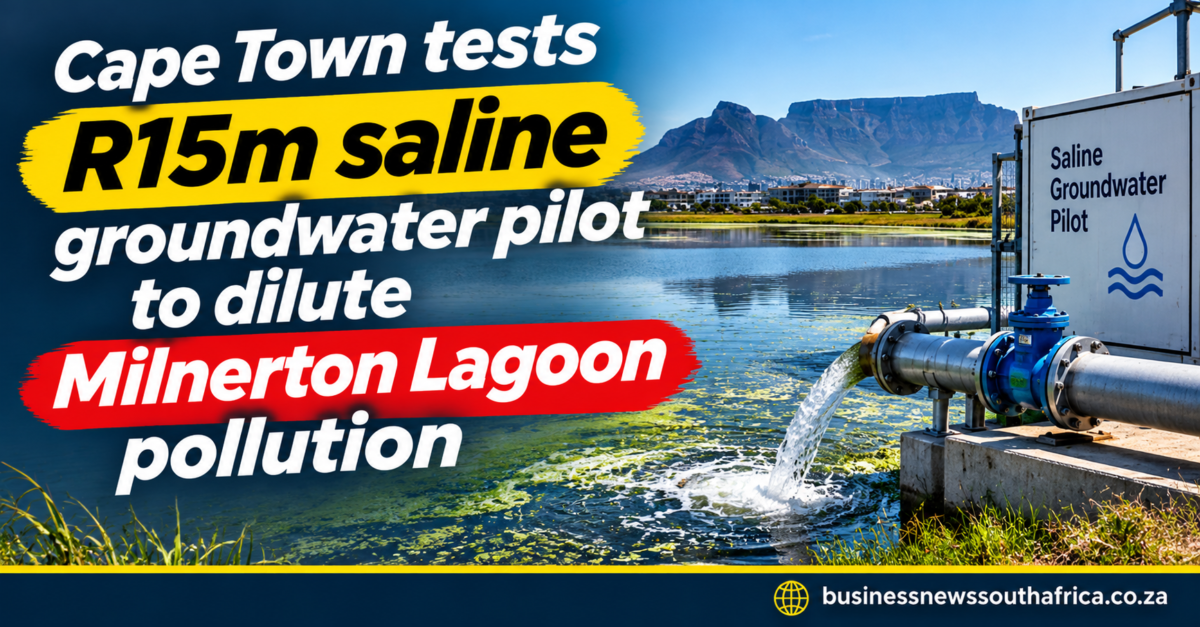
The City of Cape Town is testing whether saline groundwater pumped from beneath Milnerton Beach can clean up Milnerton Lagoon, in a pilot that GroundUp reports costs R15 million. The trial is designed to dilute pollutants rather than stop them at source, and a University of Cape Town scientist says that distinction matters.
What the City says the pilot does
The idea first appeared in the City’s own 1 April 2026 update on the lagoon. It described a saline water trial in which, from September 2026, a pilot would introduce 80 to 100 litres per second of saline water from Milnerton Beach well points to improve flows, dilute pollutants and reduce odours. That release did not give a cost.
According to Table Talk, which cited a City statement, drilling of the beach wells began on Wednesday 16 September and was expected to continue for two weeks. The City said the project will test whether the water can improve flushing, dilute pollutants and raise dissolved oxygen and salinity in the lagoon. It planned to start adding water to the lagoon in early October, followed by a six-month trial. During that time the City will monitor water quality, environmental conditions and the system’s technical performance, and the results will decide whether the project continues, is modified or is discontinued.
The City’s Eddie Andrews described the work as a pilot whose purpose is to test the intervention under real conditions while carefully monitoring its environmental performance. Table Talk reports the City will keep working with affected parties including the Milnerton Golf Club and the Sunset Links Homeowners Association, and that the Beach Wells Project is being carried out under a Section 28(4) directive issued under the National Environmental Management Act. GroundUp gave the same directive detail.
The R15 million figure and what is not confirmed
The R15 million cost comes from GroundUp, published on 5 November and carried by News24 and Moneyweb. We did not find the amount in the City’s April update or in the September statement as reported by Table Talk, so the figure rests on GroundUp’s reporting. None of the coverage we read says who is paying beyond the City itself, and we could not confirm from a City source today that water is already flowing into the lagoon, only that this was the planned start in early October.
Why the pilot is contested
GroundUp quotes UCT’s Professor Kevin Winter as saying the City’s water-quality data show some improvement since 2024, with fewer bacteria and lower levels of ammonia, nitrogen, phosphorus and chlorophyll. He said that in 2026 the water at Woodbridge Island Bridge is in some cases getting closer to the better quality seen in 2018. He called the pilot a “bold experiment” that should raise dissolved oxygen and salinity, but said it does not deal with the sources of pollution and that the sea once again receives the pollution. In his words, “Dilution of pollution is not the solution”.
The main source, according to GroundUp, is poorly treated effluent from the Potsdam Wastewater Treatment Works, which releases more than 40 million litres a day into the Diep River about 5km upstream of the lagoon. GroundUp, citing Department of Water and Sanitation data, says Potsdam has failed to meet national effluent standards since 2018. Other sources it lists include stormwater from Joe Slovo and Montague Gardens, sewer collapses, pump station overflows and farm runoff in the upper catchment.
Caroline Marx, who heads the environment portfolio at the Milnerton Central Residents Association and Rethinkthestink, told GroundUp that E. coli at Woodbridge was recorded at 141 000 colony-forming units per 100ml on 8 September, against a limit of 4 000 for safe canoeing, and that it stayed above that threshold for at least a month. The most recent reading, on 20 October, was 1 600, which GroundUp says is classed as an acceptable risk, although nitrogen, ortho-phosphate and un-ionised ammonia were still at unacceptable levels.
The Potsdam upgrade and the dredging question
Water and sanitation mayoral committee member Zahid Badroodien told GroundUp the pilot does not detract from the City’s investment in wastewater infrastructure, including the R5.2 billion Potsdam upgrade that began in April 2023 and is still under construction. He said rainfall, tidal exchange, lagoon-mouth conditions, sewer overflows and stormwater also influence the results. GroundUp reports that 65 million-litre-a-day membrane bioreactor filters were installed at Potsdam in October, that the City puts the upgrade at 80% complete, and that Mayor Geordin Hill-Lewis says the plant’s capacity will rise from 47 to 100 million litres a day when the full upgrade finishes next year.
Dredging is a second strand. The City’s April update said a tender was being evaluated, with works expected to start in June 2026 to create a defined channel, reshape sandbanks and manage the lagoon mouth. An earlier City release of 5 September 2024 put the cost of a dredging plan at around R70 million. GroundUp says the City did not answer its question about the current status of the dredging plan, and Marx raised concerns that redistributing dredged material inside the lagoon may not give a lasting environmental benefit.
What it means for ratepayers and local business
The lagoon sits among the Milnerton and Century City neighbourhoods, where water quality affects property, tourism and recreation businesses. For ratepayers across the metro, the pilot is a modest outlay next to the R5.2 billion Potsdam programme, but its value depends on the six-month results the City has promised to use. Water infrastructure pressures are a theme elsewhere too, as in our coverage of Cape Town’s long-term water plan and the SAHRC’s Gauteng water inquiry report. More on this beat is in Regulatory & Policy.
What is still unknown
Still open are the pilot’s measured results, whether the early October start went ahead as planned, who bears the R15 million, and when dredging will begin. The City has said it will decide after the six-month trial whether to continue, change or stop the project.