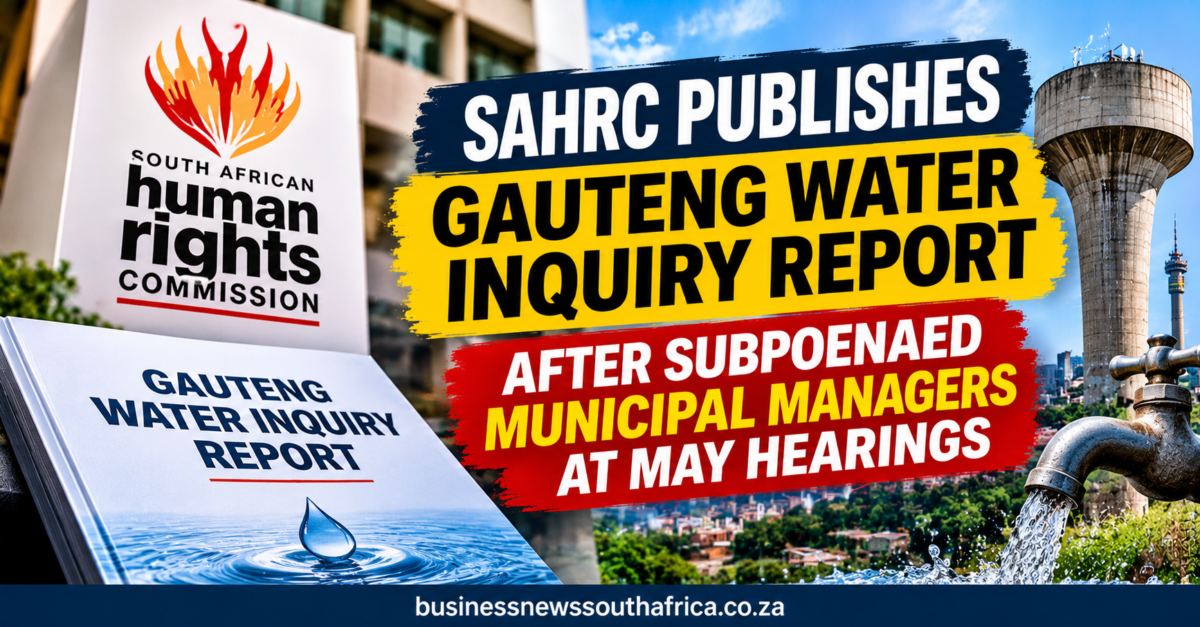
The South African Human Rights Commission (SAHRC) has published its inquiry report into water and sanitation in Gauteng, finding that the province’s problems cannot be put down to a shortage of water. In a media statement dated 2 November 2026, the commission said its Gauteng Provincial Office released the report after a formal inquiry held from 19 to 21 May 2026. The report makes eight overarching recommendations.
What the commission says it found
According to the SAHRC, sufficient water resources are currently available to meet demand. The main challenges arise from interconnected failures across the water-services value chain: ageing infrastructure, high water losses, inadequate maintenance, insufficient storage and pumping capacity, electricity interruptions, wastewater treatment failures, technical skills shortages and financial constraints. The report stresses that responsibility must be assessed at the point where a failure, decision or omission occurred, and that municipalities, bulk-water providers, electricity providers and national and provincial departments must each exercise their mandates.
The report also describes what it calls a “road-based water distribution network”, meaning the recurring delivery of drinking water by vehicle, either to communities directly or to static communal tanks, as part of a municipality’s ongoing system. The commission found that in some communities this has become a regular part of ordinary water provision. It says the reality should be recognised, but warns against normalising it or entrenching an inferior permanent level of service.
The eight recommendations
The statement singles out several of the recommendations. One is a prioritised programme to recover failing and at-risk wastewater treatment systems, ranked by the risk to human health, water resources and downstream users. Another asks Gauteng municipalities, Rand Water and other water services providers to work with the South African Police Service to protect infrastructure against theft, vandalism and deliberate damage. A third covers the resilience of the bulk-water system: identifying critical vulnerabilities, better preventative and predictive maintenance, appropriate redundancy, and a municipal assessment of whether reservoir storage is an adequate buffer against bulk-water interruptions.
The Department of Water and Sanitation, the Gauteng Department of Cooperative Governance and Traditional Affairs and the three metropolitan municipalities are asked to consider guidelines for the safe, reliable, accessible and cost-effective operation of road-based water distribution while moving towards sustainable longer-term services. The commission says it will monitor implementation and report publicly on progress. The SAHRC also gave notice of the launch in a media briefing notice of 30 October, which said the inquiry was prompted by numerous and persistent complaints over an extended period.
Subpoenas at the May hearings
The subpoenas belong to the hearing stage, not to the report release. The SAHRC statement does not name any official who was subpoenaed. Daily Maverick, reporting from the hearings on 21 May, said the inquiry chairperson, commissioner Henk Boshoff, revealed that of the six municipal managers called before the panel, only one came voluntarily and the others had to be subpoenaed. It reported that nobody from the Rand West City Local Municipality attended. BusinessTech says some municipal managers received repeated notices before attending. The commission’s senior legal officer, Khululiwe Sithole, told 702 that the difficulty of getting municipalities to take part reflected what residents face when they complain to their local authorities, according to BusinessTech.
The inquiry’s terms of reference, as reported before the hearings, were to assess the extent and root causes of water-access problems across Gauteng, how they affect rights, particularly for vulnerable communities, and whether the situation amounts to a systemic human rights violation. It also covered governance, planning, budgeting, infrastructure management, emergency response and the rise of informal water distribution economies, often called tanker mafias, according to Engineering News.
Figures reported from the inquiry
The SAHRC’s statement carries no loss or backlog figures, so the numbers below are as reported by BusinessTech and have not been checked against the report. BusinessTech says roughly 50% of Gauteng’s water is lost through leaks and failing networks. It reports that Johannesburg loses about 45% and has an estimated R27-billion renewal backlog, Tshwane about 39% with a R23-billion backlog, Rand West about 58% and Emfuleni about 57%. It also reports that Emfuleni had no capital budget for water and sanitation for two consecutive years and about R7-billion in unauthorised, irregular and wasteful expenditure, and that Merafong owes Rand Water about R1.5-billion, which has led to a 40% restriction on bulk supply.
Some figures from the May hearings differ. Daily Maverick reported Emfuleni’s municipal manager saying nearly 70% of its water was lost to leaks, and that Merafong’s historical debt to Rand Water was more than R1-billion. eNCA quoted Rand Water chief executive Sipho Mosai as saying about 33% of the water the utility supplies to Gauteng is lost to leaks. These are different measures, taken at different points, and we have not reconciled them.
On money, Sithole said in the BusinessTech report: “It’s not that we don’t have money, or we don’t have water; it’s just not being used right.” She added that if municipalities fail to provide reports showing steps being implemented, the commission would consider other avenues, including litigation.
What it means for businesses
The SAHRC statement does not set reporting deadlines. BusinessTech says municipalities must report back within three to six months, with some requirements extending to 12 months; that timetable is not in the commission’s statement, so it should be treated as unconfirmed until the full report is read. For firms that depend on municipal supply, the practical points are the focus on bulk-supply resilience and wastewater plants, both of which affect industrial users, and the tanker dependence that adds cost for municipalities and residents.
Supply pressure has been building. Our earlier reports covered Rand Water warning municipalities it may cut supply over record demand, the outage rates in Durban and Johannesburg and the liquidity shortfalls across seven of eight metros. More coverage sits under Regulatory & Policy.
What is still unknown is how municipalities and departments will respond, and whether any referral to law enforcement follows. Daily Maverick reported in May that the panel was considering involving the SAPS, the Hawks and the Special Investigating Unit on tanker systems; the November statement does not say whether that has happened.