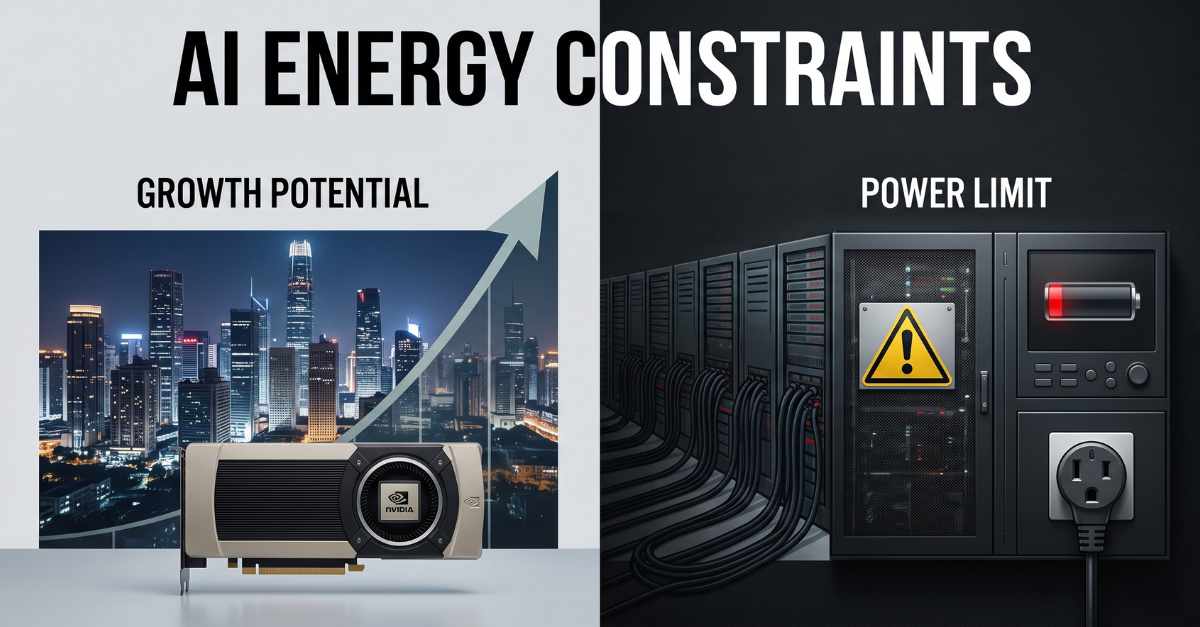
Speaking on the Right Side Broadcasting Network, technology leaders Elon Musk, Jensen Huang, and Tom Brown argued that AI energy constraints now form the primary structural bottleneck to scaling artificial superintelligence across global markets.
The structural shift from silicon to power generation
The physical realities of energy production are rapidly overriding chip availability as the dominant factor in artificial intelligence development. As computational models scale to handle complex reasoning tasks, the primary challenge facing technological development has moved from software design to steady state electricity generation.
According to Jensen Huang, chief executive of Nvidia, every layer of modern software and hardware architecture has required a total redesign to accommodate artificial superintelligence. “Every single layer of the computing stack has been reinvented. This way of doing computing unlike previous ways of retrieving information, this is a generative approach to computing and therefore in order for us to succeed the first thing we need is energy,” Huang said.
This shift in technical requirements has elevated power generation to the center of global economic competition. Elon Musk, chief executive of SpaceX and Tesla, pointed out that international edge in computing will be decided by raw megawatt capacity rather than purely digital innovation. Musk highlighted that China currently produces roughly three times the electricity of the United States, placing Western technology hubs under pressure to rapidly expand their energy grids.
“You’ve got to scale energy, you’ve got to scale chip production. and I I think we’re we’re winning on software on on anything intellectual or digital. but long in the long run we need to be able to generate enough power to compete,” Musk said.
AI energy constraints are reshaping global computing power
The relationship between energy output and national economic expansion is becoming increasingly direct as continuous compute clusters require gigawatts of reliable power. Musk outlined a personal rule of thumb connecting steady state electricity production directly to broader output, estimating that every 5 gigawatts of continuous power added to the system drives roughly a 1% increase in gross domestic product. While this formula represents Musk’s own working calculation rather than a peer-reviewed macroeconomic finding, it reflects the scale at which technology firms are planning their infrastructure investments.
“The average power consumption in the United States is about 500 gawatt. So every 5 GW of incremental steadyst state production is a 1% increase in in the power used and and I think actually will materialize to be approximately 1% increase in GDP.”
Elon Musk
To address these demands, technology firms are turning to alternative power architectures and off-grid solutions. Musk stated that Tesla and SpaceX are targeting 200 gigawatts of annual solar panel manufacturing capacity. A key component of this strategy involves evaluating orbital data centers deployed via SpaceX Starship rockets, which recently completed orbital flights carrying Starlink V3 payloads.
Musk explained that space-based solar generation offers significant operational advantages over terrestrial installations. Solar capture in orbit operates continuously without atmospheric interference or night cycles, yielding five to eight times the effective energy output of ground installations without requiring large battery storage systems.
Data centers transformed into superintelligence factories
The shift toward far larger computational requirements is changing how physical data facilities are built and understood. Huang argued that traditional terminology no longer captures the true economic function of modern infrastructure, describing upcoming installations as production centers designed to generate value rather than passive storage sites.
“We call them data centers because that’s where we hold data. But the things that we’re building now, these are really SI factories, super intelligence factories. And the reason why it’s a factory is because you’re producing something of economic value,” Huang said.
This industrial transition is driving significant employment across non-digital sectors. Huang estimated that constructing between 10 and 20 gigawatts of annual superintelligence facility capacity across the United States creates approximately 1 million industrial, construction, electrical, and pipe-fitting jobs each year.
Building facilities of this magnitude also requires deep collaboration with local communities. Musk shared that his recent infrastructure expansion included constructing a $250 million municipal water recycling plant for the surrounding municipality alongside providing half-price Starlink connectivity to local residents. For local energy planners, this mirrors the structural shifts highlighted when energy expert Andy Calitz urges South Africans to demand 8,760 hours of power each year to sustain national economic activity.
Hardware sandboxing and real time safety auditing
As sovereign compute capacity expands, managing autonomous software systems requires hardware-level oversight rather than simple software controls. Huang detailed Nvidia‘s launch of the Open Shell runtime environment, which functions like a secure browser permission framework for autonomous agents, alongside specialized Bluefield processing chips designed to continuously monitor system behavior from outside the primary execution environment.
“Even though even though you have it contained, you should never trust that it’s contained. And so you want to monitor it in real time. And you want to ideally monitor it with another another chip so that it is outside.”
Jensen Huang
This focus on hardware-level safety aligns with newly signed voluntary agreements across the artificial intelligence sector. Musk confirmed that executives recently signed a White House joint declaration committing leading technology laboratories to independent third-party audits, mutual monitoring, and joint oversight boards.
Simultaneously, autonomous capabilities continue to advance rapidly across commercial applications. Tom Brown, co-founder of Anthropic, noted that their Opus 5.5 release allows systems to manage multi-step, complex workflows independently. As discussed in context when Anthropic’s CEO just asked the entire AI industry to slow down, balancing execution capabilities with rigorous oversight remains a priority for software developers.
What business leaders can take from the warning
Beyond heavy infrastructure and safety protocols, the panel emphasized that practical adoption remains the single most important action for business leaders. Musk stated that integrating software tools into professional workflows is rapidly becoming a baseline requirement across every industry sector.
“I think it really will become essential if it isn’t already for people to use AI for in their professional lives certainly and and in their private lives. So, AI is just an incredibly helpful, useful thing,” Musk said.
Huang shared his own executive routine, explaining how he uses tools like Claude for weekend strategic research. By entering complex comparative analysis prompts, Huang obtains structured reports complete with comparative data charts in 3 minutes, replacing what previously required 6 to 8 hours of manual data collection and synthesis.
This shift in routine highlights how executive time allocation is changing. As explored when examining how Sam Altman and Jensen Huang have both said the same thing to founders, focusing on direct productivity gains through personal technology experimentation remains essential for executive leadership.
Applying this to a South African business
For a South African owner or executive, the primary takeaway is that physical energy supply will define technology availability long before software design hits a boundary. While domestic cloud initiatives are making progress, such as when Johannesburg Switches On What Its Builders Call Africa’s Most Powerful AI Cloud, national electricity grid constraints mean local companies cannot rely solely on centralized public utilities to support automated infrastructure.
South African business leaders should consider three key operational adjustments:
- Evaluate alternative power generation and battery storage options alongside any major IT infrastructure or data center expansion to prevent operational downtime.
- Establish clear permissions and hardware-isolated sandboxes before allowing autonomous software tools access to core corporate databases or transactional systems.
- Require management teams to build multi-variable research and analysis prompts directly into their weekly routines to reduce manual reporting workloads.
Enterprise resilience will depend on bridging the gap between digital ambition and energy supply, ensuring local operations remain functional regardless of external power grid pressures.