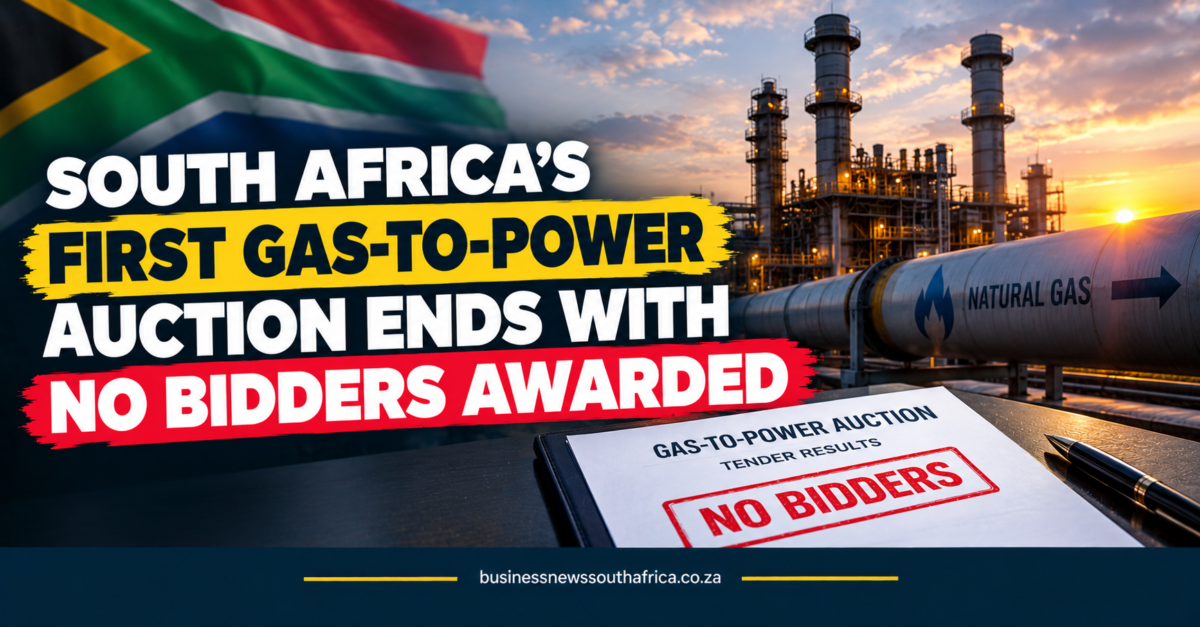
South Africa’s first dedicated gas-to-power auction has ended without a single project being awarded. Electricity and Energy Minister Kgosientsho Ramokgopa announced on Wednesday 28 October 2026 that no preferred bidders were appointed and no generation capacity was awarded in the first bid window of the Gas Independent Power Producer Procurement Programme (GASIPPPP), according to the statement the Department of Electricity and Energy issued on gov.za.
The window was meant to buy 2,000MW of new gas-fired generation. Four bids totalling 2,830MW arrived on 29 May 2026, which means the market offered about 41% more capacity than the department wanted. None of them passed.
Bidders could not prove they could get gas
The department says the request for proposals required bidders to provide assurances that they could secure gas for their plants. In its words, the bidders were unable to give those assurances “to the level required in the RFP”, and this was “one of the main reasons” none of them satisfied the mandatory functional criteria. The statement therefore says no preferred bidders were appointed.
The department also noted that South Africa imports most of its gas from Mozambique and has no liquefied natural gas (LNG) receiving terminal. It did not set out in the statement what a bidder would have needed to show beyond that.
The four bids, as listed by energy analyst Chris Yelland in a Moneyweb analysis, were Khanyazwe Flexpower (440MW, Mpumalanga), Pictor GTP Consortium (990MW, KwaZulu-Natal), Kelvin Redevelopment (600MW, Gauteng) and Komatipoort Power (800MW, Mpumalanga). The government statement does not name the bidders or say which criteria each one failed, so the individual results are not public.
A process that has been stretched over almost three years
The programme’s own page says the request for proposals was launched on 14 December 2023, with bids originally due on 30 August 2024 and preferred bidders targeted about three months later, according to the IPP Office gas programme site. Deadlines were extended repeatedly. Yelland writes that bidders had raised concerns about fuel supply, gas pricing, minimum operating requirements, infrastructure dependencies and risk allocation. A substantially revised request for proposals was issued on 20 October 2025, and the final deadline became 29 May 2026.
Yelland also traces earlier attempts. A Request for Information for roughly 3,000MW went out in May 2015, and a 2016 information memorandum described the plan as LNG-based, with about 2,000MW at Richards Bay and 1,000MW at Coega. Neither became a formal tender. The 2020 emergency programme, the Risk Mitigation IPP Procurement Programme, named eight initial preferred bidders in March 2021, including three Karpowership floating projects, but the projects missed their financial close deadlines and, according to Yelland, none delivered electricity. His count is “11 years” without new gas-fired IPP capacity from the dedicated programmes. That is his assessment, though the dates he cites match the history above.
What happens next
The department says it is not retreating from its gas-to-power goals. Ramokgopa said: “Our responsibility now is to address the infrastructure, commercial and institutional conditions required to translate market interest into viable and deliverable projects.”
One section of the statement is headed “Strengthening the enabling environment for a successful BW1.5”, which points to a revised follow-up round, and Yelland describes it as a provisional name. The statement gives no design, requirements or dates. Any later procurement, it says, will need statutory, governance and procurement approvals, and the department promises to communicate further information “before the end of the calendar year”. It also says it will continue structured engagement with market participants, including equipment makers, lenders, gas suppliers and terminal developers. No second window date has been announced.
Reuters, in a report carried by Business Day, adds that the country is developing its first LNG import terminal with ExxonMobil and Eskom as anchor clients. The department’s statement does not say when it will be ready.
What it means for business and power supply
The same report quotes the Industrial Gas Users Association of Southern Africa (Igua-SA) calling the failure a “disaster”. Executive officer Jaco Human said it should now trigger urgent intervention at presidential level. Reuters says industrial gas clients are scrambling for alternative supply before deadlines in 2028 and 2030, with about 75,000 direct jobs and R700bn in annual economic activity at stake. We reported on that supply squeeze in our piece on the looming gas shortage for manufacturers.
For electricity users, the immediate effect is that no new gas-fired capacity from this round will be built. The department calls gas-to-power critical for the adequacy and flexibility of the electricity system. Bloomberg, reported by BusinessTech, says the country relies on coal for about 80% of its electricity and had planned to shut 8GW of coal capacity by 2030 under the Integrated Resource Plan 2025, with 6GW of gas-fired generation as the replacement. Those are Bloomberg’s figures, and the government statement does not repeat them. Yelland’s analysis, by contrast, cites a 3,000MW gas allocation in the 2019 plan.
The result also bears on a recent ministerial determination that prioritises batteries and gas for the next round of procurement, which we covered in Government prioritises batteries and gas over wind and solar.
What remains unknown
The department has not said when a revised round will open or how it would handle gas supply. Yelland argues that further deadline extensions and document amendments are unlikely to fix a circular problem: power projects cannot reach financial close without gas supply, while gas infrastructure developers want assured demand before they commit. That is his view, not the department’s.
More is in our Energy & Infrastructure coverage.