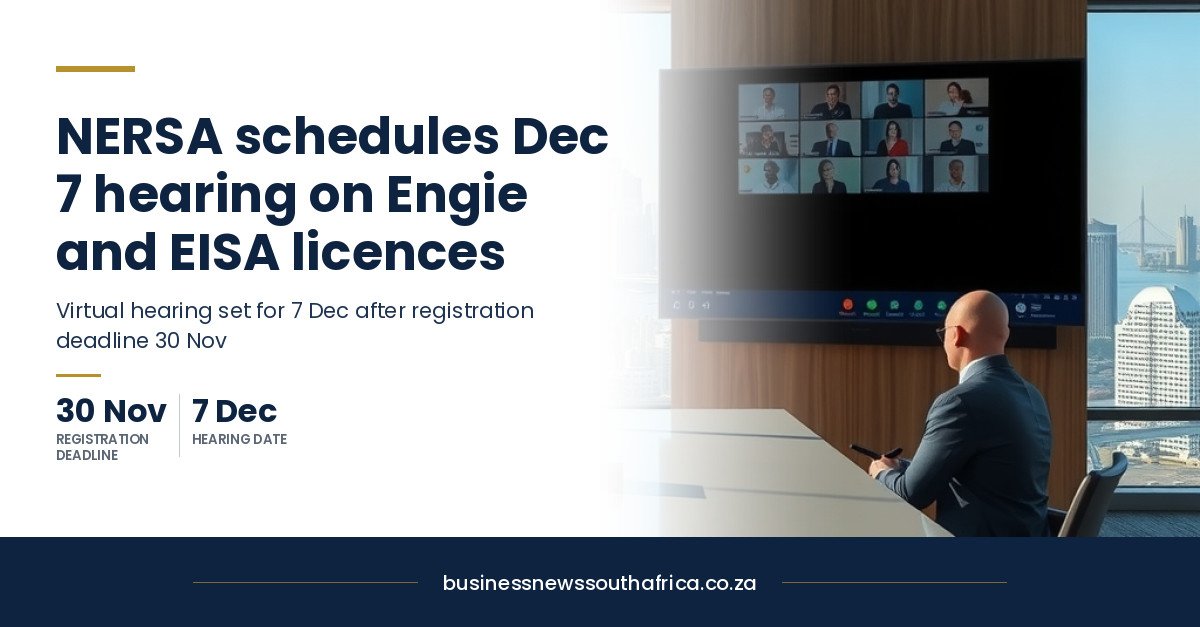
The National Energy Regulator of South Africa (NERSA) has called a public hearing for 7 December 2026 on two electricity licence applications: a trading licence sought by Engie Energy Marketing South Africa (Pty) Ltd and an import-export licence sought by Energy Exchange of Southern Africa (Pty) Ltd. The notice on NERSA’s website gives anyone who wants to speak until 16:30 on 30 November 2026 to register. For companies that buy large volumes of power, the filing shows that private electricity traders are still applying to the regulator.
What the regulator’s notice says
NERSA’s notice lists two applicants. Engie Energy Marketing South Africa has applied for a trading electricity licence, with the location given as the Eastern Cape and KwaZulu-Natal and the distributor in the area described as “customers supplied by Eskom”. Energy Exchange of Southern Africa has applied for an import-export electricity licence, with the location given as South Africa and the SADC region and Eskom listed as the distributor.
The hearing runs from 09:30 to 13:00 on 7 December as a virtual meeting on MS Teams, with a live stream on X. Anyone who wants to attend or make oral representations must send a request by 16:30 on 30 November to NERSA’s public hearings office. People who cannot join can send written comments to TdLicenseApplications@nersa.org.za. The application forms, according to the notice, sit on NERSA’s website under Notices and then Public Hearings.
One line in the notice matters for anyone planning to take part. A hearing on a particular application “will not take place” if no party has registered to make representations on it. In that case registered attendees are notified and a cancellation notice goes on the website. The regulator is not promising a hearing for each application, only one if someone registers to speak.
Two different licences
A trading licence concerns the buying and selling of electricity, and is what Engie is seeking for customers in two provinces. An import-export licence concerns cross-border flows of power. The notice does not say what either company intends to do with its licence, and we have not seen the application forms, so we do not describe their plans. We could not find a statement from Engie or Energy Exchange about these applications.
The licensing dispute with Eskom is on hold
Trading licences have been contentious. According to Engineering News, NERSA approved four trading licences and the country’s first private import-export licence, to GreenCo Power Services, on 29 October 2024, after Eskom’s distribution division objected at public hearings in July 2024. Eskom later went to court. Engineering News and IOL reported in February 2026 that Eskom, NERSA and the traders had agreed to stay Eskom’s review of the licences so that NERSA could finish its trading rules. IOL said the stay was not a withdrawal of the review application. We could not open those two reports ourselves, so treat this paragraph as secondary reporting.
The rulebook is still a draft
Those trading rules are still in draft. Alexandra Felekis and Busisiwe Nhlapo of law firm Bowmans, in commentary published on 21 July 2026, write that NERSA has released Version 3 of the draft rules for public comment. They say that under the draft, licensed traders will not be allowed to buy or sell electricity directly in the planned wholesale market during Phases 1 and 2 of market reform, and that virtual wheeling will only be available once that market is live, only for customers with connections larger than 100 kVA, and only after various operational and regulatory requirements have been met. These are the lawyers’ reading of a draft, not final rules, and we have not seen the draft text itself. The notice gives no timetable for finishing the rules.
What this means for businesses that buy power
For a manufacturer, miner, retailer or property owner, more licensed traders could mean more suppliers and contract structures to compare. A trading licence does not set a price, and nothing in the notice says that Eastern Cape or KwaZulu-Natal customers will see offers, or when. Companies weighing a wheeling or trading deal can still take part in the hearing, and the trading rules still to be finalised will govern deals signed now. Our earlier reporting covers the end of Eskom’s monopoly in 2027, how bills are becoming harder to read as the market opens, NERSA’s proposed ban on automated trading in the wholesale market, Ekurhuleni’s authority to buy 2,400MW from private producers and a property group’s solar project aimed at cutting reliance on Eskom.
What is still unknown
- What either company plans to do with its licence, and which customers it has lined up. The notice gives only the type of licence and the regions.
- Whether anyone will register to speak. Without a registration the hearing on that application is cancelled.
- Whether Eskom, named as the distributor for both applications, will object.
- When NERSA will decide, and whether the final trading rules will be in place first.